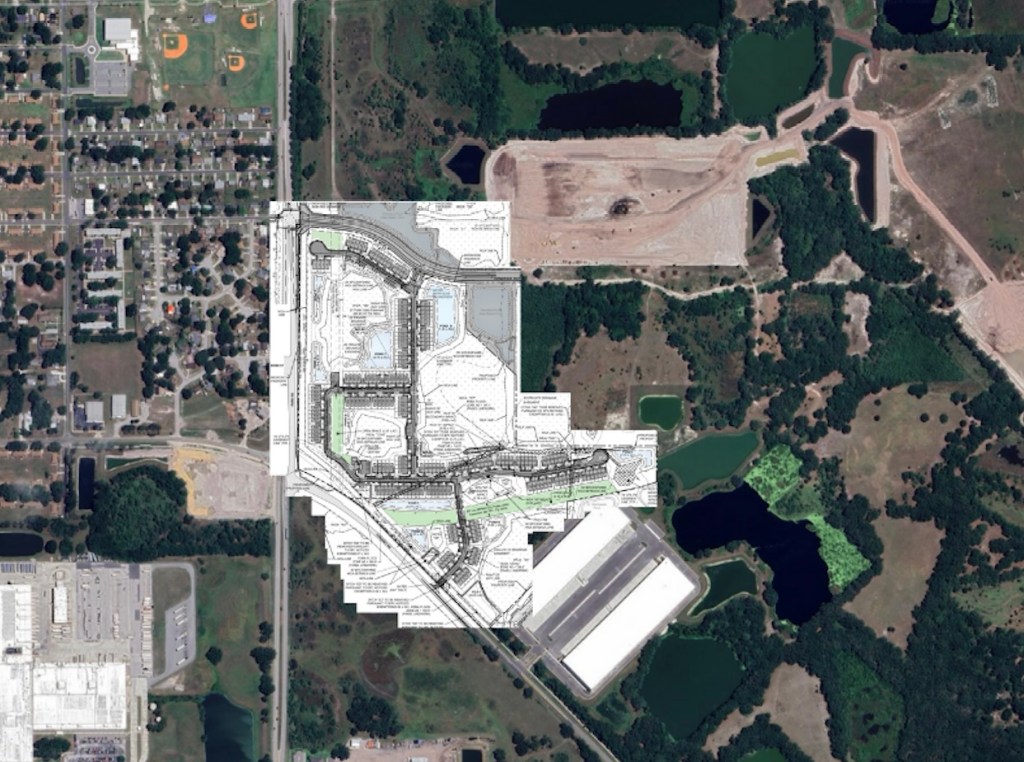
The property under consideration is a brownfield area previously slated for industrial use. However, recent permit filings indicate a shift in plans. The site, encompassing approximately 54 acres, is set to host 183 new townhome units upon full build-out. While the area is designated as a brownfield, this classification does not necessarily confirm the presence of hazardous substances. Rather, it reflects the potential for such substances due to the property’s history and the existence of other brownfield sites on neighboring parcels.
Currently, the parcel is vacant, though an active gas transmission line runs north to south along the western portion of the property. The development plan includes two entrances: one on Coronet Road and another on the newly constructed section of Henderson Way, which connects to Park Road. At the Coronet Road entrance, a stop sign will control exiting traffic, but no traffic light is planned. The permitting documents do not specify whether a traffic light will be installed at the intersection of the Henderson Way extension and Park Road. Over time, Henderson Way is intended to become a continuous road throughout the entire Lakeside Station development, reconnecting with the existing portion of Henderson Way within the industrial area.
Understanding Brownfield Sites
According to the Environmental Protection Agency (EPA), a brownfield site is defined as follows:
“With certain legal exclusions and additions, the term ‘brownfield site’ means real property, the expansion, redevelopment, or reuse of which may be complicated by the presence or potential presence of a hazardous substance, pollutant, or contaminant.”1
Importantly, redevelopment of a brownfield site involves comprehensive measures to assess and, if necessary, remediate the land to ensure its suitability for construction and habitation. This process is distinct from addressing superfund sites, which are significantly more contaminated and pose severe threats to public health. Remediating a superfund site often requires extensive, multi-year efforts.
Brownfield redevelopment projects, such as the one proposed for this property, benefit from various governmental grants and programs designed to offset cleanup costs. These initiatives support the safe and efficient transformation of underutilized or potentially contaminated properties into productive community assets.
Broader Implications
The redevelopment of brownfield sites offers significant benefits, including economic revitalization, increased housing availability, and the mitigation of environmental concerns. By transforming these areas, developers can contribute to sustainable urban growth while addressing potential environmental hazards. Projects like the townhome development on this site exemplify the potential to balance economic development with environmental responsibility, ensuring that previously underutilized land can serve new and meaningful purposes for the community.
Interestinly, the new South Florida Baptist Hospital was built on a brownfield site that had an area that was known to have contaminants.



 Plant City Insider
Leave a reply to Staff Writer Cancel reply